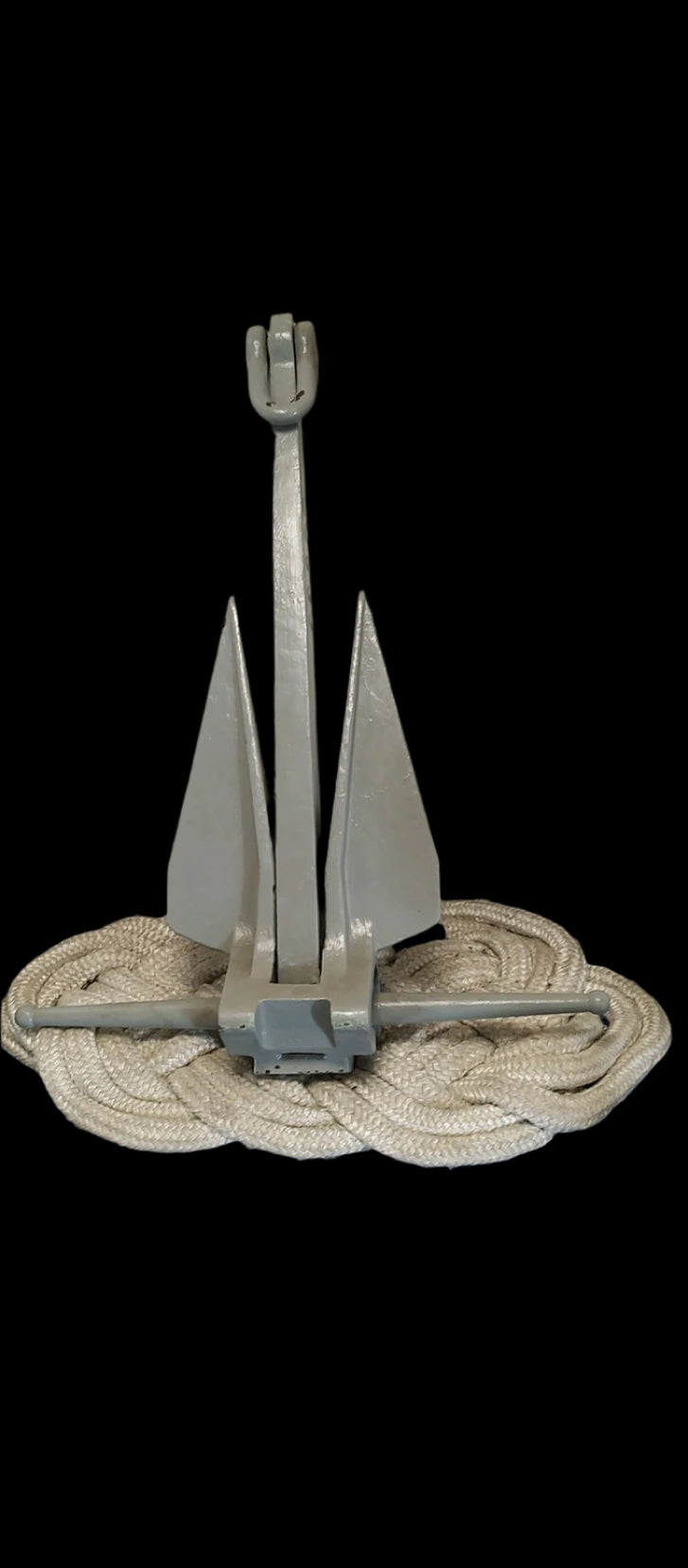


US Naval Academy Original YP 676 Class Training Ship - Anchor circa 1980
US Naval Academy Original YP 676 Class Training Ship - Anchor circa 1980
Couldn't load pickup availability
Own a Genuine Piece of U.S. Naval Academy History!
Annapolis Maritime Antiques is proud to offer an extraordinary opportunity to acquire authentic YP 676-Class Training Ship anchors—direct from the storied fleet of the U.S. Naval Academy.
These original stockless anchors stand approximately 4' 6" tall and weigh exactly 300 lbs. Each piece tells a tale of midshipmen seamanship training and Naval tradition.
Two purchase options available
- As-is condition — $975
- Fully reconditioned, display-ready — $1,650
Photos show both the rugged as-is state and a professionally restored presentation example.
Please Contact Us to Arrange Delivery & Shipping. Options Below -
- Local pickup available in Annapolis, Maryland
- White glove delivery within 50 miles — $350
- Extended delivery available — priced by mileage and time
- Custom-built shipping crate — $325
- Nationwide shipping available — cost based on freight rates
Whether for a maritime collection, museum display, or statement décor, these anchors embody the legacy of Naval craftsmanship and training. Quantities are limited.
History of these storied ships and anchors
The YP 676-class training ships at the U.S. Naval Academy were equipped with anchors designed for reliability, ease of handling, and suitability for nearshore operations—ideal for their role in seamanship training.
Anchor Type & Configuration
- Type: Typically fitted with stockless Navy-type anchors, which are compact and stow easily in the hawsepipe.
- Material: Forged steel, corrosion-resistant for long-term saltwater exposure.
- Weight: 300# per anchor
- Quantity: Most YP 676-class vessels carried two bow anchors, one port and one starboard, mounted in recessed hawsepipes.
Anchor Handling Systems
- Windlass: Manual or hydraulic windlass system located on the foredeck, used for raising and lowering anchors.
- Chain: Heavy-duty galvanized steel anchor chain, sized to match the anchor weight and vessel displacement.
- Chain Locker: Located below the foredeck, where chain is stowed when anchors are retrieved.
Training Applications
Midshipmen learned:
- Proper anchoring techniques including scope calculation, bottom type assessment, and holding power.
- Anchor watch procedures, including monitoring for drag and maintaining position.
- Emergency anchoring drills, simulating loss of propulsion or steering.
Design Notes
- Anchors were integrated into the hull design of the YP 676 Class training ship's for streamlined stowage and quick deployment.
- The YP 676’s wood hull and aluminum superstructure required careful corrosion management around anchor fittings.
- Anchor handling was part of broader seamanship evolutions, including mooring, towing, and underway recovery.
Purpose & Mission
- Provide at-sea training in navigation, seamanship, and officer-of-the-deck duties.
- Support Plebe Summer, Sea Trials, and other developmental evolutions.
- Teach Basic Damage Control pier side familiarization, and advanced underway operations.
YP 676-Class Yard Patrol Craft — A Legacy of Seamanship Training
The YP 676 class represents a pivotal evolution in the U.S. Navy’s training fleet, designed specifically to prepare midshipmen at the U.S. Naval Academy for real-world shipboard operations. These vessels replaced earlier classes like the YP 660, offering improved maneuverability, durability, and training capacity.
Historical Background
- Built between the late 1980s and early 1990s, primarily by Peterson Builders and Marinette Marine.
- Designed as dedicated training platforms, not converted yachts or fishing vessels like earlier WWII-era YPs.
- Served as the primary seamanship training craft at the Naval Academy until the introduction of the more modern YP 703 class.
Design & Capabilities
|
Feature |
Specification |
|---|---|
|
Length |
108 ft (32.9 m) |
|
Beam |
24 ft (7.3 m) |
|
Draft |
8 ft (2.5 m) |
|
Speed |
12 knots |
|
Range |
1,800 nautical miles |
|
Propulsion |
Two 12V-71N Detroit Diesel engines |
|
Hull Material |
Wood hull, aluminum superstructure |
|
Crew Capacity |
2 officers, 4 enlisted, up to 50 people |
These vessels were built with robust maneuvering characteristics, including excellent turning performance and directional stability—confirmed by model testing at the David Taylor Naval Ship Research Center.
Training Role
- Used extensively for navigation, seamanship, and officer-of-the-deck training.
- Supported Plebe Summer, Sea Trials, and underway operations.
- Provided a safe yet realistic shipboard environment for midshipmen to learn damage control, watch standing, and engineering systems.
Transition & Legacy
- Many YP 676-class vessels were decommissioned or sold in the 2010s as the YP 703 class took over.
- Some, like YP 697, were repurposed for research or private use.
- Their legacy lives on in the generations of officers trained aboard them.